Why people buy USDT at all
USDT is a stablecoin pegged to the dollar: one coin is always worth roughly one dollar. It does not rise and fall like ordinary crypto, so it is used as a means of settlement rather than as an investment.
The main practical value is independence from banking routes. The coins go directly and arrive in minutes, at night, on weekends and on holidays included.
- Paying foreign services and contractors that do not take cards of Russian banks
- Sending money to family abroad, to be exchanged into local currency there
- A dollar equivalent without a currency account at a bank
Three ways to buy
| Option | The rate | The main risk |
|---|---|---|
| An exchange | The market one | Getting rubles in runs into the same banking step |
| P2P | Its own in every listing | The money comes from a stranger |
| An exchange service | One rate, locked before payment | The rate has to be compared by the final amount |
Why the USDT rate is above the Central Bank dollar
This is the first thing that surprises people when buying: the dollar at the Central Bank costs one thing and USDT noticeably more. The reason is simple: the official rate of the regulator and the price the coin actually trades at are different things.
Counting USDT at the Central Bank rate would be pleasant in a calculation and impossible in practice: nobody will sell the coin at that price. So the correct source for USDT is an exchange quote, not the regulator's reference.
Choosing the network
USDT has several networks, and the coin in each of them is technically a different asset with a different address. The network is chosen not by the fee but by what the recipient, or the exchange you are sending to, accepts.
- First — where you are sending — check the network with the recipient or in the destination wallet
- Then — the fee — networks differ in the cost of a transaction, but only among those that fit
- Never — by eye — sending in an unsuitable network is irreversible, and support cannot fix it
Where the money is lost
-
Comparing by percentage
A 0% fee at a rate two percent worse than the market costs more than 1% at an honest rate.
-
Double conversion
Rubles into dollars, dollars into USDT — the rate applies twice. A direct pair is better.
-
Splitting the purchase
The network fee does not depend on the amount: ten small transfers mean ten fees.
-
A floating rate
If the rate is set at the moment of delivery rather than of the request, the result is unknown in advance.
How it works with us
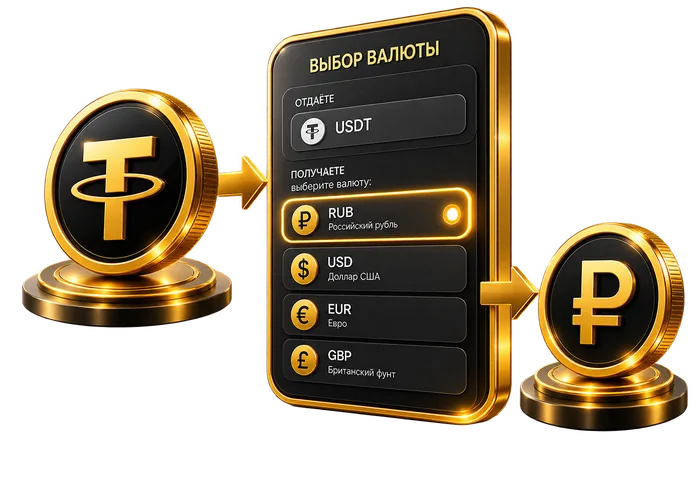
We sell USDT as the other side of the deal: the rate comes from an exchange and is locked before payment, and the 1% fee is already in the calculator. You can pay by transfer or in cash at an office.
The manager confirms the network of the transfer before payment — as a separate step, because a mistake in it is irreversible. There are no limits on our side.
-
The rate from an exchange
The one the coin trades at, not derived from the Central Bank dollar.
-
A 1% fee
Already taken off in the calculator — you see the result, not a figure before deductions.
-
The network is confirmed
Before payment. Sending in an unsuitable network is irreversible.