Three ways to cash out
-
Through an exchange service
The other side is a company. The rate is locked before the deal, and the money arrives to an account or is handed out in cash.
-
Through an exchange
The rate is the market one, but cashing out into rubles runs into the same banking step — and the same questions about the incoming payment.
-
In cash
At an office by arrangement. It suits when a bank account is inconvenient or does not exist.
What to prepare before the deal
- The exact amount in coins — keeping in mind that the network fee is charged on top of it
- The network of the transfer: one and the same coin has several of them, and they are not compatible
- The details for receiving the money: an account, a card or an arrangement about cash
- An understanding of the currency you want to be paid in: rubles, dollars, local currency
About the network of the transfer
The most expensive mistake when cashing out is sending coins in the wrong network. An address from one network does not exist in another, and the transaction goes nowhere: it cannot be reversed by a service or by exchange support.
That is why the network is agreed before sending and confirmed separately — that is not bureaucracy but the only protection from an irreversible loss.
How to count the gain
A payout has three parts: the exchange rate, the service fee and the network fee. The last one does not depend on the amount, so on small payouts it is noticeable and on large ones almost invisible.
Hence a practical consequence: splitting a payout into many small transactions is doubly unprofitable — both in network fees and in the attention a series of identical payments draws from the bank.
| Part | What it depends on | Can it be influenced |
|---|---|---|
| The exchange rate | On the service and on the pair | Yes — by comparing final amounts |
| The service fee | On the tariff | Yes — by choosing the service |
| The network fee | On the load and on the network chosen | Yes — by the network and the size of the payout |
What the bank will say
An incoming payment from a company looks fundamentally different to a bank than a transfer from a private person: it has a sender, a reference and a clear nature. That does not rule out questions, but it removes the main one.
Keep the history of the deal — the confirmation of the exchange, the rate, the date. That is exactly the document people are asked for when they are asked.
How it works with us
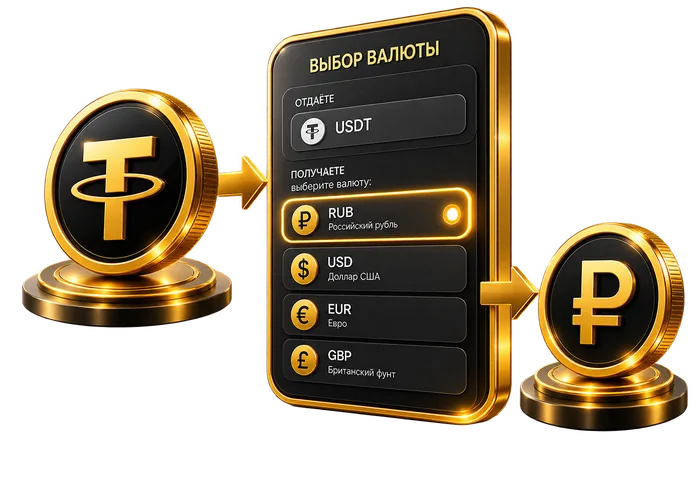
We buy the coins as the other side of the deal: the rate comes from an exchange, is locked before payment, and the fee is 1%. The money can be taken in rubles, in currency or in cash at an office.
The manager confirms the network of the transfer before sending. There are no limits on our side.
-
The rate from an exchange
Not derived from the Central Bank dollar but the one the coin actually trades at.
-
The network is confirmed
Before sending, as a separate step — because the mistake is irreversible.
-
Rubles, currency or cash
You choose how to be paid, and the tariff does not depend on it.