How it works
P2P is an exchange between people directly, where the platform only acts as a guarantor: it holds the seller's coins locked while the buyer sends the money. As soon as the seller confirms receipt, the coins go to the buyer.
The scheme is honest and there is nothing wrong with the platform itself. The risk appears at the banking step — at the moment a transfer from a person you know nothing about lands on your card.
The main risk: someone else's money on your card
If the money you were paid with was obtained criminally, your card becomes a link in the chain of its movement. The bank sees an incoming payment from a person who has come to its attention and restricts operations on the account — regardless of whether you knew anything.
Sorting it out then falls on you: it is you who has to prove things, not the bank. And the worst part is that preventing it on your side is next to impossible: you are in no position to check where someone else's money came from.
In P2P you take money from a person you do not know and answer for it with your own account.
Other ways to lose
-
A payment reversal
The buyer sends the money and, after getting the coins, disputes the transfer with their bank. The coins are gone and the money went back to them.
-
Payment by the wrong person
The money comes from the account of a third person. For the bank that is splitting and transit, for the platform it is grounds for a dispute.
-
A deal outside the platform
The offer to do it directly and skip the fee removes the only protection there is — the coins locked by the guarantor.
-
The payment reference
The words crypto, USDT or exchange in the payment reference are a direct invitation for questions from the bank.
How to reduce the risk if you still choose P2P
- Work only inside the platform, never stepping out into a direct deal
- Take money only from the person whose name is stated in the deal
- Write nothing about cryptocurrency in the payment reference
- Do not split a large amount into a dozen small transfers — that is exactly the pattern banks look for
- Keep the history of your deals: screenshots, order numbers, correspondence
How an exchange through a service differs
In an exchange through a service the other side is a company rather than a random person. The money comes from its accounts, and the question of who the payment came from looks fundamentally different to the bank.
That does not make an exchange magically safe, but it removes the main risk of P2P: you no longer answer with your account for a stranger's money.
| Feature | P2P | An exchange through a service |
|---|---|---|
| The other side | A stranger | A company |
| The source of the money | Cannot be checked | Known |
| Who settles a dispute | The platform's arbitration | The service, by the terms of the deal |
| The rate | Its own in every listing | One rate, locked before payment |
| Risk for your card | The main risk of the scheme | Substantially lower |
How it works with us
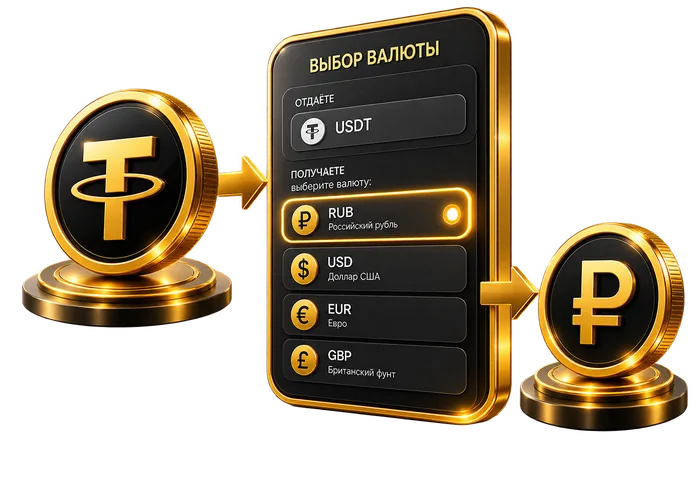
We act as the other side of the deal: you exchange coins with a company rather than with a private person. There is one rate, it comes from an exchange and is locked before payment, and the fee is 1%.
The exchange works both ways — buying coins for rubles and selling them with a payout in rubles or currency. Cash at an office works for this too.
-
The other side is a company
Not a private person and not a random counterparty from a platform.
-
One rate
From an exchange, locked before payment. With no haggling over every listing.
-
Both ways
Buying for rubles and selling with a payout — on the same terms.